


Spaces of Memory and Imagination - Reflection of Literature
- Oct 23, 2015
- 4 min read

We have an innate capacity for remembering and imagining places. Perception, memory and imagination are in constant interaction; the domain of presence fuses into images of memory and fantasy. We keep constructing an immense city of evocation and remembrance, and all the cities we have visited are precincts in this metropolis of the mind.
Literature and cinema would be devoid of their power of enchantment without our capacity to ‘enter’ a remembered or imagined place. The places and spaces enticed by a work of art are real in the full sense of the experience. ‘Tintoretto did not choose that yellow rift in the sky above Golgotha to signify anguish or provoke it. It is anguish and yellow sky at the same time. Not sky of anguish or anguished sky; it is an anguish become thing, anguish which has turned into yellow-rift of sky,’ writes Sartre.
Similarly, the architecture of Michelangelo does not present symbols of melancholy; his buildings actually mourn. When experiencing a work of art, a curious exchange takes place; the work projects its aura, and we project our own emotions and precepts on the work. The melancholy in Michelangelo’s architecture is fundamentally the viewer’s sense of his/her own melancholy enticed by the authority of the work. Enigmatically, we encounter ourselves in the work.
Memory takes us back to distant cities, and novels transport us through cities invoked by the magic of the writer’s word. The rooms, squares and streets of a great writer are as vivid as any that we have visited; the invisible cities of Italo Calvino have forever enriched the urban geography of the world. The city of San Francisco unfolds in its multiplicity through the montage of Hitchcock’s ‘Vertigo;’ we ‘enter’ the haunting edifices in the steps of the protagonist and see them through his eyes. We ‘become’ citizens of mid-19th-century St Petersburg through the incantations of Dostoyevsky. We ‘are’ in the room of Raskolnikov’s shocking double murder, we ‘are’ among the terrified spectators watching Mikolka and his drunken friends beat a horse to death, frustrated by our inability to prevent the insane and purposeless cruelty.
The cities of filmmakers, built up of momentary fragments, envelop us with the full rigor of real cities. The streets in great paintings continue around corners and past the edges of the picture frame into the invisible with all the intricacies of life. ‘[The painter] makes [houses], that is, he creates an imaginary house on the canvas and not a sign of a house. And the house which thus appears preserves all the ambiguity of real houses,’ writes Sartre.
There are cities that remain mere distant visual images when remembered, and cities that are remembered in all their vivacity. The memory re-evokes the delightful city with all its sounds and smells and variations of light and shade. I can even choose whether to walk on the sunny side or the shaded side in the pleasurable city of my remembrance. The real measure of the qualities of a city is whether once can imagine falling in love with it.
Juhani Pallasmaa
Pallasmaa, J. (2010). The thinking hand. Chichester, U.K.: Wiley, pp. 72-77.

KEY WORDS WITHIN ABSTRACT
Remembering/ remembrance
Imagining
Perception/ precepts
Memory
Evocation
Aura
INSIGHTFUL QUOTES WITHIN ABSTRACT
“Perception, memory and imagination are in constant interaction.”
“When experiencing a work of art, a curious exchange takes place; the work projects its aura, and we project our own emotions and precepts on the work."
REFERENCED PHILOSOPHERS AND CORRESPONDING THEORIES
“Tintoretto did not choose that yellow rift in the sky above Golgotha to signify anguish or provoke it. It is anguish and yellow sky at the same time. Not sky of anguish or anguished sky; it is an anguish become thing, anguish which has turned into yellow-rift of sky.”
- Sarte
“[The painter] makes [houses], that is, he creates an imaginary house on the canvas and not a sign of a house. And the house which thus appears preserves all the ambiguity of real houses.”
- Sartre
REFERENCED PHILOSOPHERS AND CORRESPONDING THEORIES
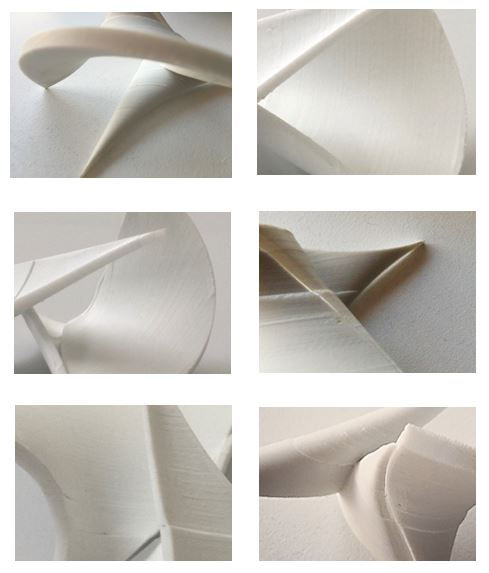
I agree with the assumption that a cognitive engagement transpires between the imaginative psyche of the individual and their comprehension of expressive spatial conditions in architecture. Although this type of phenomenological dialogue remains purely speculative in nature, I believe that it is the key to our understanding of our immediate surroundings in architecture – and further to that – of ourselves. This is because I think the human mind is incredibly strong and powerful because of its capacity to retain a wealth of knowledge and memories. These cognitive functions can be activated within designed environments from meaningful encounters with elegant, beautiful and powerful sculptured forms that carve through space, creating an arena for imagination and memory to incite the perceiving individual. This cognitive engagement between an individual and architecture spurs an interactive dimension between the self and the mind, stimulating the thought process of the intellect as they deliberate, analyse and reflect all that comes to mind in this space.
...Please follow my other accounts for more information on this exciting discussion!!
Catherine K


Comments